Author Amanda Lohrey shares her tips for writing a great short story:
It’s difficult to generalize about what makes for a good short story. I once sat on a panel of three judges for a short story competition that attracted over 400 entries. We whittled that number down to a short-list of twelve and all twelve stories were first-rate – and all were different. Here, however, are a few broad-stroke guidelines:
1. A story should lock into one of your obsessions or you won’t bother to finish it.
2. It shouldn’t be in any way predictable, including to you while you’re writing it. It’s good not to be sure where you’re going.
3. After a first, second or third draft, leave it to cook in the oven of your unconscious for at least a month, preferably 3-6 months (longer even).
4. If a story isn’t working try changing the voice from third person to first – or vice versa – or the point-of-view from one character to another.
5. Poets sometimes assert that poetry differs from prose because in a poem every word counts. They’re wrong. In a story every word counts as well. Even a simple thing like a sentence that has too many occurrences of ‘a’ or ‘the’ in it can wreck the rhythm of a paragraph. Be ruthless in purging cliché and lazy phrasing from your drafts (unless deliberately planted in the idiomatic speech of a character). Purging cliché helps to avoid flatness of tone. Flatness of tone is death to a story.
6. The ending of a story should be both surprising and yet feel inevitable. This is the paradox of what readers think of as a good ending. If the right ending doesn’t come to you then the story needs more cooking (see 3).
7. Be like a film director – work on several story projects at once. You never know which one(s) are going to turn out well.
8. A story is a message in a bottle and not everyone will get the message. Some of my favorite stories by other writers have been rejected by famous editors. If someone doesn’t like your story, don’t fret. Write another story.
9. Hold your nerve. Don’t censor at source and take at least one major risk of self-exposure in writing the story. Something has to be at stake, including that you might make a fool of yourself. If that’s not happening then the story probably isn’t worth writing.
10. Don’t worry about what your mother will think. She’ll surprise you.
Amanda Lohrey's new collection of short stories Reading Madame Bovary is available now in all good bookstores.
Monday, August 30, 2010
Father's Day Gift Ideas
Looking for a great book to give your Dad this Father's Day? Here are our suggestions:
The Well at the World's End by AJ Mackinnon is an astonishing true story of a remarkable voyage by a modern-day adventurer. Read more.
Looking for Australia is a engaging collection of essays about Australian culture by historian John Hirst. Read more.
In A Game of Our Own, esteemed historian Geoffrey Blainey documents the fascinating history of the AFL. Read more.
The Skull is an irresistible true-crime story about Australia's most feared policeman, Brian “Skull” Murphy. Read more.
In Rise of the Ruddbot, Australia’s funniest, most incisive political commentator, Annabel Crabb, chronicles the last few years of Australian politics. Read more.
In The Family File, Mark Aarons tells the story of how his family became the most monitored family in Australian history: his father, uncle, grandmother and grandfather were leaders of the Communist Party of Australia. Read more.
In The Family Law, Benjamin Law writes a linked series of hilarious and moving essays about his weird but wonderful family. Read more.
In Secrets of the Grown-Up Brain, a leading science writer examines how the brain reaches its peak in middle age, and how to keep it there. Read more.
In Axis of Deceit Andrew Wilkie tells the story of how he resigned from Australia's senior intelligence agency in protest over the looming Iraq war in 2003. He was the only serving intelligence officer from the Coalition of the Willing - the US, the UK and Australia - to do so. Read more.
Wednesday, August 4, 2010
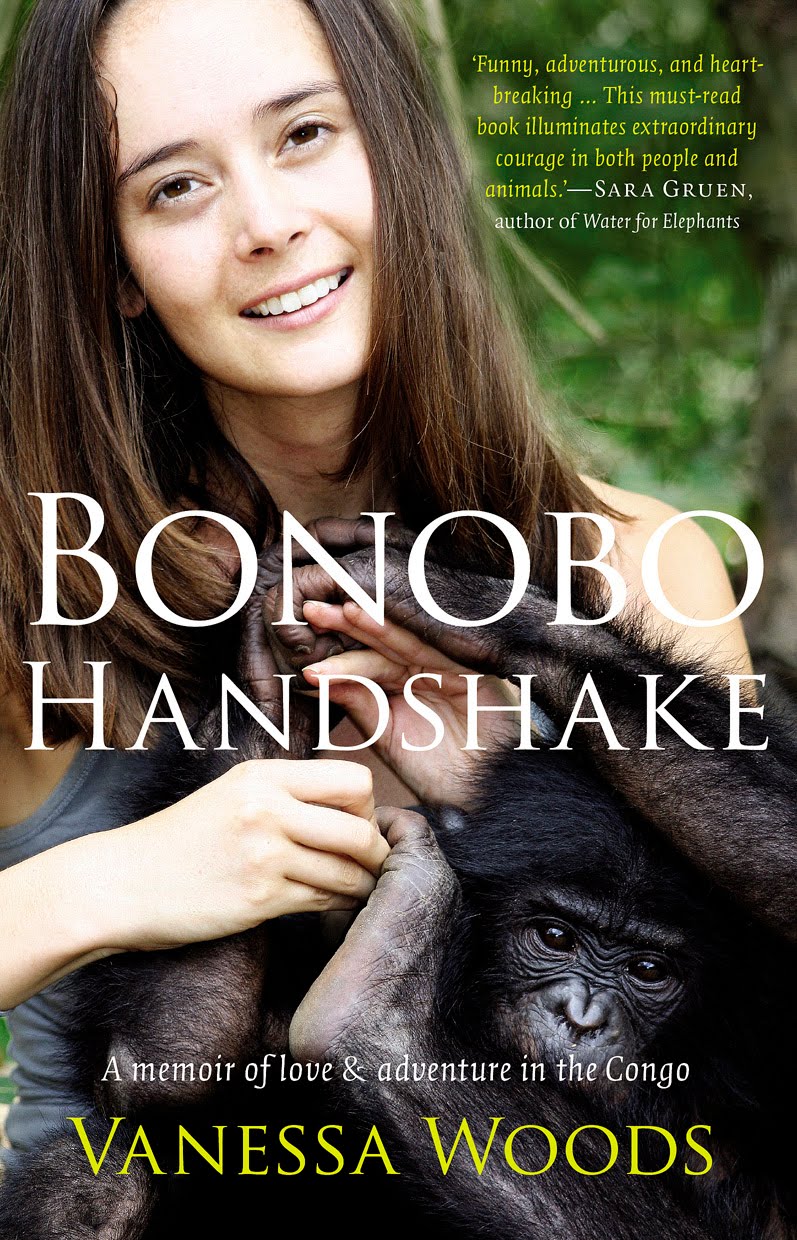
Vanessa Woods on her memoir Bonobo Handshake
We interview Vanessa Woods, author of Bonobo Handshake: A Memoir of Love and Adventure in the Congo.
What are bonobos?
For the last forty years, we humans have compared ourselves to chimpanzees. It turns out chimpanzees have a type of culture. They make tools. They use gestures to communicate. They have sophisticated political systems and emotions that can only be described as love, grief, and jealousy.
Even the dark side of our nature that we thought was exclusively ours, such as hunting and war, is found in chimpanzees too. A chimpanzee community, similar to many human communities, is male-dominated. Females can be raped, infants might be killed. As a chimp, you have more chance of being killed by another chimp than by anything else.
But we have another closest living relative.
Bonobos look almost exactly like chimpanzees, except they have black faces, pink lips, and hair parted down the middle. They only live in one country, the Democratic Republic of the Congo. Their populations are so scattered that it is impossible to know how many there are, although current estimates are between ten thousand and forty thousand.
Most people barely even know there are two “closest living relatives” to humans. Like an embarrassing relative, bonobos are frequently missing from the family tree. According to Microsoft Word’s spell-check, bonobo isn’t even a word.
In the 1980s that Frans de Waal published a study of bonobos in the San Diego Zoo. He saw tongue kissing, fellatio, and a kama sutra of sexual positions. Before de Waal, people thought that nonconceptive sex, or “sex for fun,” was unique to humans. But bonobos were having sex in all sorts of crazy ways, including the missionary position, which no one had ever seen in an animal. De Waal also concluded that bonobos were female-dominated and that compared to chimps, they committed very little violence. He suggested that here was another model for human behavior, one that didn’t include war and bloodshed.
How did you come to find yourself studying bonobos in the Congo?
It was a series of happy accidents. Like most people, I had no idea what a bonobo was. Then I fell in love with an anthropologist whose dream was to study bonobos in Congo… so off we went!
In what ways are bonobos and chimpanzees different to work with?
Chimpanzees are so focused on the task. They’ll sell their soul for a banana. If they get the answer wrong, sometimes they’ll get so upset that they’ll refuse to participate. Bonobos are completely different. You usually have to have a quick ‘bonobo handshake’ before you start. And then they’re more likely to do cartwheels around the room for half an hour rather than do the test. So we have to make sure the experiments are fun, more like games than work. We can’t force anybody to participate!
Do you have a favourite bonobo?
Yes! Her name is Kata. She is the sweetest bonobo ever, and she gives me a great big hug every time I see her.
Why is protecting bonobos so important?
When I wake up this morning, someone might try to kill me. I live 10 minutes from a small town called Durham, NC, where according to the last statistics, 22 people were killed, 76 women were raped, and there were 682 cases of aggravated assault.
When a chimpanzee wakes up in the morning, they probably have the same thought. In fact, if you're a male chimpanzee, you're more likely to be killed by another chimpanzee than anything else. If you're a female chimpanzee, expect to be beaten by every adolescent male who is making his way up through the ranks.
People often ask me why humans are so intelligent, as in, what is it other apes lack that makes us so unique.
I'll tell you this: I would swap every gadget I own - my car, my laptop, the potential to fly to the moon - if I could wake up as a bonobo. No bonobo has ever been seen to kill another bonobo. There is very little violence towards females. The infants get an idyllic childhood where they do nothing but hang out with their moms and get anything they want. There is plenty of food. Lots of sex. And yet, according to one of our studies, 75% of people have no idea what a bonobo is.
This isn't really our fault. It's been 13 years since Frans de Waal published Bonobo: The Forgotten Ape, and since then, there has not been one popular book published on bonobos until I wrote Bonobo Handshake.
But it's also because politicians, scientists, and the media have been trying very hard to pretend they don't exist. Why?
Bonobos have gay sex. For bonobos, sex is a mechanism to reduce tension. And you can't talk about two females rubbing clitorises together until they orgasm in documentaries, intelligent design classes, or to right wing demographics who believe homosexuality is unnatural.
Bonobos are not considered to be family friendly, despite the fact that children can see people cut up, blown up and shot before 8pm on television.
When it comes to scientists, even scientists who I like and admire, only ever refer to 'our closest living relative, the chimpanzee'. There is never any mention that we have TWO closest living relatives, the chimpanzee and the bonobo.
If scientists do speak about them, they are constantly trying to neuter them. Bonobo researchers get annoyed by bonobos' reputation of being the over sexed ape, and are constantly downplaying the differences between bonobos and chimps. Even in cognition studies, despite Kanzi, bonobos are rarely tested for cognition because 'we've already done this in chimps, why should we do it in bonobos?'
As for politicians, bonobos never had a chance. Acknowledging the existence of an ape who shares 98.7% of our DNA (suggesting descent with modification i.e. evolution), has homosexual interactions, and is female dominated, is completely out of the question.
As a lemur scientists once said to me, 'So what? No one knows about sifakas' (the dancing lemurs, even though they do, because of the cartoon Madagascar) 'why should bonobos be any different?'
Because bonobos hold the key to a world without war. Their physiology, biochemistry, and psychology is set up to avoid violence. The fact that sex is their mechanism to reduce tension is irrelevant. We need to study the hell out of bonobos and use our big fat brains to find our own mechanism so we can live peacefully.
We've had 26 days without war since WWII. Right now, there are 7 conflicts throughout the world killing over 1,000 people a year. In Congo alone, 1,500 people die every day. Despite cognitively knowing that we need to cooperate and get along, our emotions get in the way.
We have to find a way to be more like bonobos. They share 98.7% of our DNA. What's in that 1.3% that makes them the way they are? And if we can use hummingbird flight to make helicopters and cat's eyes to make reflector lights, why can't we use bonobos to make peace on earth?
2010 is going to be the year of bonobos. With my book coming out, Sara Gruen releasing the first fiction about bonobos, and the bonobo genome due any day, expect bonobos to move to the front of public consciousness.
What made you want to write this book?
I wanted to write this book because I was puzzled by the scientific community’s rejection of the bonobo’s uniqueness, their sexuality, and their place in the wider question of what makes us human. I’m tired of meeting blank stares of people when I say I work with bonobos. I want everyone to know what bonobos are!
What’s next for you?
Right now, I’m enjoying talking about bonobos to everyone, from the New York Times to the Adelaide Advertiser. I’m hoping as more people read the book, more people will realize how important they are, and why we should care about their future. Then I suppose it’s back to Congo☺
Bonobo Handshake is available in all good bookstores. To read more about Vanessa, you can visit her website or her blog.
What are bonobos?
For the last forty years, we humans have compared ourselves to chimpanzees. It turns out chimpanzees have a type of culture. They make tools. They use gestures to communicate. They have sophisticated political systems and emotions that can only be described as love, grief, and jealousy.
Even the dark side of our nature that we thought was exclusively ours, such as hunting and war, is found in chimpanzees too. A chimpanzee community, similar to many human communities, is male-dominated. Females can be raped, infants might be killed. As a chimp, you have more chance of being killed by another chimp than by anything else.
But we have another closest living relative.
![]() |
| Mimi |
Most people barely even know there are two “closest living relatives” to humans. Like an embarrassing relative, bonobos are frequently missing from the family tree. According to Microsoft Word’s spell-check, bonobo isn’t even a word.
In the 1980s that Frans de Waal published a study of bonobos in the San Diego Zoo. He saw tongue kissing, fellatio, and a kama sutra of sexual positions. Before de Waal, people thought that nonconceptive sex, or “sex for fun,” was unique to humans. But bonobos were having sex in all sorts of crazy ways, including the missionary position, which no one had ever seen in an animal. De Waal also concluded that bonobos were female-dominated and that compared to chimps, they committed very little violence. He suggested that here was another model for human behavior, one that didn’t include war and bloodshed.
How did you come to find yourself studying bonobos in the Congo?
It was a series of happy accidents. Like most people, I had no idea what a bonobo was. Then I fell in love with an anthropologist whose dream was to study bonobos in Congo… so off we went!
In what ways are bonobos and chimpanzees different to work with?
Chimpanzees are so focused on the task. They’ll sell their soul for a banana. If they get the answer wrong, sometimes they’ll get so upset that they’ll refuse to participate. Bonobos are completely different. You usually have to have a quick ‘bonobo handshake’ before you start. And then they’re more likely to do cartwheels around the room for half an hour rather than do the test. So we have to make sure the experiments are fun, more like games than work. We can’t force anybody to participate!
Do you have a favourite bonobo?
![]() |
| Vanessa with Kata |
Why is protecting bonobos so important?
When I wake up this morning, someone might try to kill me. I live 10 minutes from a small town called Durham, NC, where according to the last statistics, 22 people were killed, 76 women were raped, and there were 682 cases of aggravated assault.
When a chimpanzee wakes up in the morning, they probably have the same thought. In fact, if you're a male chimpanzee, you're more likely to be killed by another chimpanzee than anything else. If you're a female chimpanzee, expect to be beaten by every adolescent male who is making his way up through the ranks.
People often ask me why humans are so intelligent, as in, what is it other apes lack that makes us so unique.
I'll tell you this: I would swap every gadget I own - my car, my laptop, the potential to fly to the moon - if I could wake up as a bonobo. No bonobo has ever been seen to kill another bonobo. There is very little violence towards females. The infants get an idyllic childhood where they do nothing but hang out with their moms and get anything they want. There is plenty of food. Lots of sex. And yet, according to one of our studies, 75% of people have no idea what a bonobo is.
This isn't really our fault. It's been 13 years since Frans de Waal published Bonobo: The Forgotten Ape, and since then, there has not been one popular book published on bonobos until I wrote Bonobo Handshake.
But it's also because politicians, scientists, and the media have been trying very hard to pretend they don't exist. Why?
Bonobos have gay sex. For bonobos, sex is a mechanism to reduce tension. And you can't talk about two females rubbing clitorises together until they orgasm in documentaries, intelligent design classes, or to right wing demographics who believe homosexuality is unnatural.
Bonobos are not considered to be family friendly, despite the fact that children can see people cut up, blown up and shot before 8pm on television.
When it comes to scientists, even scientists who I like and admire, only ever refer to 'our closest living relative, the chimpanzee'. There is never any mention that we have TWO closest living relatives, the chimpanzee and the bonobo.
If scientists do speak about them, they are constantly trying to neuter them. Bonobo researchers get annoyed by bonobos' reputation of being the over sexed ape, and are constantly downplaying the differences between bonobos and chimps. Even in cognition studies, despite Kanzi, bonobos are rarely tested for cognition because 'we've already done this in chimps, why should we do it in bonobos?'
![]() |
| Mikeno |
As a lemur scientists once said to me, 'So what? No one knows about sifakas' (the dancing lemurs, even though they do, because of the cartoon Madagascar) 'why should bonobos be any different?'
Because bonobos hold the key to a world without war. Their physiology, biochemistry, and psychology is set up to avoid violence. The fact that sex is their mechanism to reduce tension is irrelevant. We need to study the hell out of bonobos and use our big fat brains to find our own mechanism so we can live peacefully.
We've had 26 days without war since WWII. Right now, there are 7 conflicts throughout the world killing over 1,000 people a year. In Congo alone, 1,500 people die every day. Despite cognitively knowing that we need to cooperate and get along, our emotions get in the way.
We have to find a way to be more like bonobos. They share 98.7% of our DNA. What's in that 1.3% that makes them the way they are? And if we can use hummingbird flight to make helicopters and cat's eyes to make reflector lights, why can't we use bonobos to make peace on earth?
2010 is going to be the year of bonobos. With my book coming out, Sara Gruen releasing the first fiction about bonobos, and the bonobo genome due any day, expect bonobos to move to the front of public consciousness.
What made you want to write this book?
I wanted to write this book because I was puzzled by the scientific community’s rejection of the bonobo’s uniqueness, their sexuality, and their place in the wider question of what makes us human. I’m tired of meeting blank stares of people when I say I work with bonobos. I want everyone to know what bonobos are!
What’s next for you?
Right now, I’m enjoying talking about bonobos to everyone, from the New York Times to the Adelaide Advertiser. I’m hoping as more people read the book, more people will realize how important they are, and why we should care about their future. Then I suppose it’s back to Congo☺
Bonobo Handshake is available in all good bookstores. To read more about Vanessa, you can visit her website or her blog.
Wednesday, June 30, 2010
AJ Mackinnon on his new book The Well at the World's End
AJ Mackinnon, author of the bestselling The Unlikely Voyage of Jack de Crow, has just released his second book The Well at the World's End. We to talk to him about his new book.
The Well at the World’s End is about your travels from New Zealand to the Scottish island of Iona, what made you want to travel to Iona?
Ever since I first visited Iona as a 19 year old, the place has held a spell over me. In the book, I tell the story of bathing in the Well of Eternal Youth there, a little mountain spring with a long magical tradition, and how I mis-read the instructions in the old guide book and got it wrong. Ten years later, when I wanted to set off travelling from Australia and have adventures, it seemed a good goal to aim for - to go back and to the little enchanted island of Iona and visit the Well of Eternal Youth and do it properly this time. But even had there been no well, Iona is the sort of place that has a World's End feel to it. It is very reminiscent of all those old Celtic fairy tales where a traveller comes literally to the last shore, the place where a voyager sets out from in a magic coracle or barge, off to find the Land of Tir nan Og or the Blessed Realm. It is right on the border between mortal and fairy lands, the Uttermost West. It makes the perfect place to strive for.
You travel by land, sea, truck, train, horse and yacht – why didn’t you fly?
The answer to this goes back to something I've written in an earlier book, a bit about loving Doctor Dolittle as a child, and especially the fact that all his adventures seemed so simple, as he would set out in a little ship and just bump into places. I've always been convinced that flying has robbed travel of its true adventure. It is very convenient, very fast but very soulless as well... and terribly seductive. Once you buy into the air-route, it is very hard to get away from it again. Aeroplanes lead to airports which introduce you to more planes which deposit you at more airports... and even when these allow you to escape from the immediate loop, you find yourselves on shuttle buses to city hotels, lined with information counters and racks full of tour brochures... all of which offer a safe and easy return via shuttle bus back to the airport again. It is very easy to think that you are really seeing a country because all those airports and hotels have souvenir shops with Zulu woodcarvings or painted didgeridoos or Beefeater dolls... and before you know it, you have 'travelled' the world and never been more than 80 metres from a Tie Rack or a travelator.
Besides, the old guide book on Iona said, 'Pilgrims must come by land and by sea to find the Well of Eternal Youth,' and as I'd promised I'd do things properly this time, I forbade myself from flying.
You find yourself in some interesting situations on this trip, like the time you were chased by Komodo dragons. Were there moments on your travels when you found yourself in situations that made you wonder why you’d set out on this trip in the first place?
It was never the dangerous moments that made me question what I was doing. Those bits, even in the heat of the moment, invariably made me realise more than ever that this was exactly why I had done it this way. It is all to do with the power of story. I read the work of some scientist who said that the story-telling urge is so strong in human beings, and so important in having driven our evolution, that our scientific name really should be Pan Narrans - the story telling ape. (The idea is that making stories is really the process of trying to find cause and effect in random events, and this is the same process that drives our scientific minds and develops our brains. In stories, all the facts have to be relevant and contribute to the outcome - so too, any scientific theory as to what makes the thunder rumble or why a particle behaves as it does has to tie in with all the observable facts.) Anyway, if this is true, then I am pure ape with not much else in the mix. If something happens to me that can contribute to a good story to tell my friends later, then it is pure gold and worth all the danger or discomfort. It was only the long
periods of inactivity that made me question why I was doing things the hard way. In any travel, there are enormously long and tedious periods of sitting around waiting, or idle, discontented evenings of loneliness in city hotel rooms... and this trip was no exception. But for starters, these things don't make good telling so don't really make it into the book, and secondly, going back to the point about not flying, it is far nicer to spend three hours waiting on a sunny dockside in the Bay of Islands for a late yacht, or sitting under a flap of a tent in the Sahara Desert for a horse to be caught and broken in, than to sit in yet another airport lounge mishearing annoying announcements and wondering whether a fourth cup of Gloria Jeans coffee might be warranted.
Who is the most memorable character that you met on this trip?
I met a number of people who were memorable for the wrong reasons. Alec the psychotic skipper was unforgettable for his unpredictability and scariness, as were the Chinese policemen who arrested me and spent three days questioning me. But to balance these were some truly saintly people. Les McLeod, the long-suffering and infinitely patient skipper of a yacht that I lived on for five weeks in New Zealand not going anywhere, was one of the nicest people I have ever met. I was so incompetent in helping him with a paint job that he ended up repainting a section of the deck FIVE times to amend my botched work, and in all this never said anything but the warmest words of praise in his soft Yorkshire accent, commending me on my enthusiasm, my creativity, my flair, my doggedness... all the nicest euphemisms possible for my total bloody incompetence in getting the paint to go where it should and not all over the ropes, the portholes, my shoes, our washing and his sandwiches. Another favourite were the American yachting family, the Flying Dolphins, who took me into their hearts and lives as we sailed through the Indonesian archipelago. Still twenty years on, we still remain friends and I have visited them in the States on a number of occasions, most recently last year. The two children, Peter and Heath, are now grown up into lovely young adults, but I remember them still as beautiful children - adventurous, warm, avid for learning, wide-eyed when I told them a story or showed them some origami or taught them something extraordinary about mathematics or mazes. They were the best pupils I ever had, young Arthurs to my would-be Merlyn. But I am getting carried away...
What was your favourite part of the trip?
A hard question, but the highlights were probably the sailing through Indonesia and later my adventures up through Laos. This was back when very few western travellers made it into Laos and travel was very restricted. A lot of my travelling was done on foot along jungle roads through the mountains, and there were clouds of butterflies everywhere. The people of the villages I passed through were astonishingly gentle and kind, a little awed by seeing someone so different from themselves, and vying with each other to offer me hospitality for the night. This was the time I felt most like some 18th century traveller seeing the wonders of the world, especially when travelling up fierce rivers in tiny sampans and seeing great caverns carved into temples up remote gorges, lit by thousands of candles and with a glimpse of a golden Buddha deep in the recesses. I wonder if even today, travellers ever get to see these hidden treasures.
Do you have another adventure that you’re planning to set off on soon?
This is the commnest question that I get asked. I simply don't know. My past adventures have always been fairly spontaneous, with no great plans leading up to tem, so I imagine that if I do find myself off on another voyage, it will be a matter of being swept away again by the dwarves of adventure off to see Wilderland without even my hat or pocket handkerchief. However, next year I have arranged to take a year off work and live in my beautiful new house, just purchased, sitting right on a mountian trout river and with an acre of wonderful garden - plum trees, magnolias, candlebarks, apple trees, an oak, a corkscrew willow, and wide verandahs all around. The idea is to write another book but this time, a novel - something I've always wanted to do. I'm actually quite nervous about the prospect of doing this. True life travel books are one thing but a really good fictional story is another task altogether, and I'm not completely confident of being able to produce something worthwhile. This will also be a new experience for me in that it will be the first time of living settled in a house without my beloved students and a community of good colleagues at my doorstep, something I have always revelled in. Will I cope with the solitude and independence? But one thing that struck me the other day was this, and we have to go back yet again to Doctor Dolittle. Much as I loved the idea of Doctor Dolittle setting out on his travels, I also always loved the last paragraph of each book, his homecoming. After all the adventures, he always ended by coming up the lane and turning in at his own gate, unlocking the door with his own key and hanging his hat in the hall. In my past travels, this is something I've never had, as each voyage has been a stage to a new life abroad. But now, I love the thought of being able to go away on an adventure, knowing that I too have somewhere to come back to - a garden, a familiar stretch of river, a peaceful house, and my own desk waiting for me, to sit and write it all up for a new story to tell.
The Well at the World's End is available in all good bookstores.
The Well at the World’s End is about your travels from New Zealand to the Scottish island of Iona, what made you want to travel to Iona?
Ever since I first visited Iona as a 19 year old, the place has held a spell over me. In the book, I tell the story of bathing in the Well of Eternal Youth there, a little mountain spring with a long magical tradition, and how I mis-read the instructions in the old guide book and got it wrong. Ten years later, when I wanted to set off travelling from Australia and have adventures, it seemed a good goal to aim for - to go back and to the little enchanted island of Iona and visit the Well of Eternal Youth and do it properly this time. But even had there been no well, Iona is the sort of place that has a World's End feel to it. It is very reminiscent of all those old Celtic fairy tales where a traveller comes literally to the last shore, the place where a voyager sets out from in a magic coracle or barge, off to find the Land of Tir nan Og or the Blessed Realm. It is right on the border between mortal and fairy lands, the Uttermost West. It makes the perfect place to strive for.
You travel by land, sea, truck, train, horse and yacht – why didn’t you fly?
The answer to this goes back to something I've written in an earlier book, a bit about loving Doctor Dolittle as a child, and especially the fact that all his adventures seemed so simple, as he would set out in a little ship and just bump into places. I've always been convinced that flying has robbed travel of its true adventure. It is very convenient, very fast but very soulless as well... and terribly seductive. Once you buy into the air-route, it is very hard to get away from it again. Aeroplanes lead to airports which introduce you to more planes which deposit you at more airports... and even when these allow you to escape from the immediate loop, you find yourselves on shuttle buses to city hotels, lined with information counters and racks full of tour brochures... all of which offer a safe and easy return via shuttle bus back to the airport again. It is very easy to think that you are really seeing a country because all those airports and hotels have souvenir shops with Zulu woodcarvings or painted didgeridoos or Beefeater dolls... and before you know it, you have 'travelled' the world and never been more than 80 metres from a Tie Rack or a travelator.
Besides, the old guide book on Iona said, 'Pilgrims must come by land and by sea to find the Well of Eternal Youth,' and as I'd promised I'd do things properly this time, I forbade myself from flying.
You find yourself in some interesting situations on this trip, like the time you were chased by Komodo dragons. Were there moments on your travels when you found yourself in situations that made you wonder why you’d set out on this trip in the first place?
It was never the dangerous moments that made me question what I was doing. Those bits, even in the heat of the moment, invariably made me realise more than ever that this was exactly why I had done it this way. It is all to do with the power of story. I read the work of some scientist who said that the story-telling urge is so strong in human beings, and so important in having driven our evolution, that our scientific name really should be Pan Narrans - the story telling ape. (The idea is that making stories is really the process of trying to find cause and effect in random events, and this is the same process that drives our scientific minds and develops our brains. In stories, all the facts have to be relevant and contribute to the outcome - so too, any scientific theory as to what makes the thunder rumble or why a particle behaves as it does has to tie in with all the observable facts.) Anyway, if this is true, then I am pure ape with not much else in the mix. If something happens to me that can contribute to a good story to tell my friends later, then it is pure gold and worth all the danger or discomfort. It was only the long
periods of inactivity that made me question why I was doing things the hard way. In any travel, there are enormously long and tedious periods of sitting around waiting, or idle, discontented evenings of loneliness in city hotel rooms... and this trip was no exception. But for starters, these things don't make good telling so don't really make it into the book, and secondly, going back to the point about not flying, it is far nicer to spend three hours waiting on a sunny dockside in the Bay of Islands for a late yacht, or sitting under a flap of a tent in the Sahara Desert for a horse to be caught and broken in, than to sit in yet another airport lounge mishearing annoying announcements and wondering whether a fourth cup of Gloria Jeans coffee might be warranted.
Who is the most memorable character that you met on this trip?
I met a number of people who were memorable for the wrong reasons. Alec the psychotic skipper was unforgettable for his unpredictability and scariness, as were the Chinese policemen who arrested me and spent three days questioning me. But to balance these were some truly saintly people. Les McLeod, the long-suffering and infinitely patient skipper of a yacht that I lived on for five weeks in New Zealand not going anywhere, was one of the nicest people I have ever met. I was so incompetent in helping him with a paint job that he ended up repainting a section of the deck FIVE times to amend my botched work, and in all this never said anything but the warmest words of praise in his soft Yorkshire accent, commending me on my enthusiasm, my creativity, my flair, my doggedness... all the nicest euphemisms possible for my total bloody incompetence in getting the paint to go where it should and not all over the ropes, the portholes, my shoes, our washing and his sandwiches. Another favourite were the American yachting family, the Flying Dolphins, who took me into their hearts and lives as we sailed through the Indonesian archipelago. Still twenty years on, we still remain friends and I have visited them in the States on a number of occasions, most recently last year. The two children, Peter and Heath, are now grown up into lovely young adults, but I remember them still as beautiful children - adventurous, warm, avid for learning, wide-eyed when I told them a story or showed them some origami or taught them something extraordinary about mathematics or mazes. They were the best pupils I ever had, young Arthurs to my would-be Merlyn. But I am getting carried away...
What was your favourite part of the trip?
A hard question, but the highlights were probably the sailing through Indonesia and later my adventures up through Laos. This was back when very few western travellers made it into Laos and travel was very restricted. A lot of my travelling was done on foot along jungle roads through the mountains, and there were clouds of butterflies everywhere. The people of the villages I passed through were astonishingly gentle and kind, a little awed by seeing someone so different from themselves, and vying with each other to offer me hospitality for the night. This was the time I felt most like some 18th century traveller seeing the wonders of the world, especially when travelling up fierce rivers in tiny sampans and seeing great caverns carved into temples up remote gorges, lit by thousands of candles and with a glimpse of a golden Buddha deep in the recesses. I wonder if even today, travellers ever get to see these hidden treasures.
Do you have another adventure that you’re planning to set off on soon?
This is the commnest question that I get asked. I simply don't know. My past adventures have always been fairly spontaneous, with no great plans leading up to tem, so I imagine that if I do find myself off on another voyage, it will be a matter of being swept away again by the dwarves of adventure off to see Wilderland without even my hat or pocket handkerchief. However, next year I have arranged to take a year off work and live in my beautiful new house, just purchased, sitting right on a mountian trout river and with an acre of wonderful garden - plum trees, magnolias, candlebarks, apple trees, an oak, a corkscrew willow, and wide verandahs all around. The idea is to write another book but this time, a novel - something I've always wanted to do. I'm actually quite nervous about the prospect of doing this. True life travel books are one thing but a really good fictional story is another task altogether, and I'm not completely confident of being able to produce something worthwhile. This will also be a new experience for me in that it will be the first time of living settled in a house without my beloved students and a community of good colleagues at my doorstep, something I have always revelled in. Will I cope with the solitude and independence? But one thing that struck me the other day was this, and we have to go back yet again to Doctor Dolittle. Much as I loved the idea of Doctor Dolittle setting out on his travels, I also always loved the last paragraph of each book, his homecoming. After all the adventures, he always ended by coming up the lane and turning in at his own gate, unlocking the door with his own key and hanging his hat in the hall. In my past travels, this is something I've never had, as each voyage has been a stage to a new life abroad. But now, I love the thought of being able to go away on an adventure, knowing that I too have somewhere to come back to - a garden, a familiar stretch of river, a peaceful house, and my own desk waiting for me, to sit and write it all up for a new story to tell.
The Well at the World's End is available in all good bookstores.
Wednesday, June 2, 2010
An interview with Benjamin Law
Benjamin Law is the author of The Family Law, a collection of hilarious essays about his family.
1. Describe your book in three words…
Heartfelt. Obscene. Slitoris.*
2. How would you describe your family?
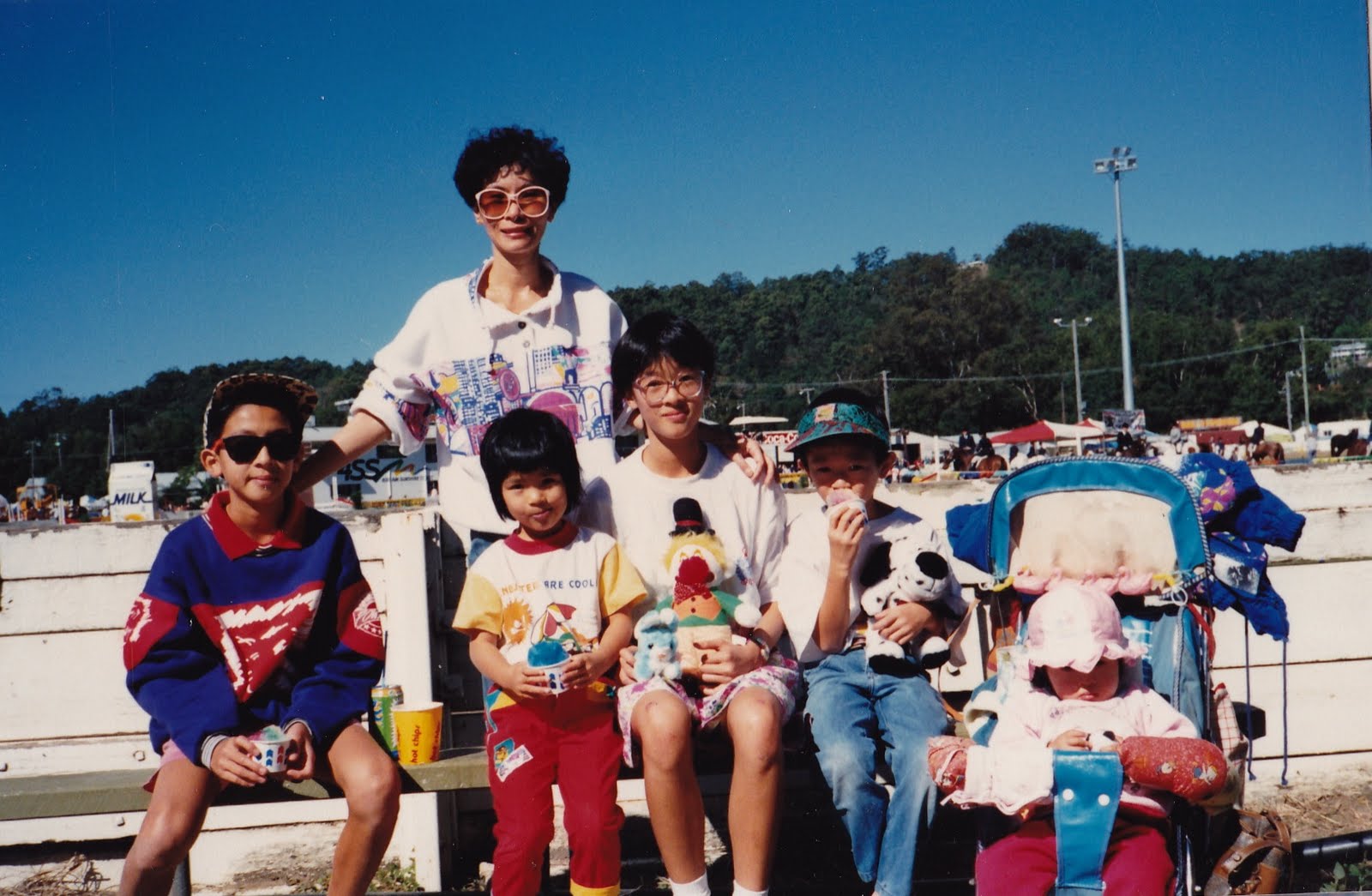
I come from the Law family, a bunch of second generation Chinese-Australians: two parents; five kids. We grew up in Coastal Queensland, even though my mother hated how sandy the beach was, and my father believed that wearing thongs would unnaturally split our toes.
My book documents growing up alongside my four siblings as we all navigated our way through our parents’ divorce, amongst other things. It’s sort of like the Wonder Years meets The Squid and the Whale, crossed with David Sedaris, except everyone eats rice.
3. What made you want to write about your family?
The short answer? Well, my family makes for great material.
In all honestly, I didn’t actually realise this until I started writing for frankie, a magazine I’ve been with for the last six years. Louise, my editor at the time, asked all the senior contributors to write a column called “My Mother’s Advice.” This was my first paragraph:
As a Chinese immigrant, my mother often gave us kids advice that sounded horrific, weird or offensive when translated to English, or taken out of cultural context. One of the most mortifying examples is something she often said to my sisters if they hadn’t showered yet, which directly translated to: “Go have a shower now, or your vagina will breed worms.
Needless to say, it spoke to people, and I’ve kept on writing about them all.
Admittedly, I sometimes struggle with the ethics of writing about people in my life. But then one of my family members says or does something so intensely funny or foul that I think, “Hell, it would be irresponsible not to write about you.”
4. What was your childhood relationship with your older brother like?
My older brother Andrew is awesome, but we are poles apart.
He beefs up at the gym; I’m medically underweight. He’s sporty and über-heterosexual; I’m a book-reading poof. We were arch nemeses growing up, but because we were the only boys in our family, we were forced to share a 3.5m-cubed cell bedroom for 16 years. Growing up, my fights with him would involve him tickling me to the point of tears, and me spitting and scratching at him, cat-like. This is all documented in the book.
5. Has your family read the book? If so, what have been their reactions?
Because of my frankie articles, I’m quite used to passing drafts of my work to family if they’re depicted in a story. Partly, it's about getting their permission, but it's also a practical thing: I want to ensure I have details correct, or at least, have them verify what happened.
(I have a horrible short to medium-term memory. Everyone who knows me will tell you this.)
All of my family members laugh and say wonderful things about the stories. But inside, I’m sure they’re all completely and thoroughly horrified. As I would be too.
6. Your Mum is a very strong character in the book – can you tell us a little more about her?
My mother, Jenny, is one-of-a-kind. She’s probably the family member I write most about. She separated from my father when we were all really young (between the ages of four and 18), and decided to approach motherhood pretty much solo, with five kids in tow.
It’s only later in life that you start to appreciate what that actually means.
Nowadays, she’s feisty, quotable and incredible frank. If she discusses her vagina and childbirth within the first few minutes of meeting you, this means she likes you.
7. What is your favourite essay or story from within the book?
I can’t pinpoint my favourite piece from the book, but I really loved writing ‘Oceans Apart,’ which is about my father.
Ever since he moved to Australia, my dad has worked seven days a week, 365 days a year — right through Christmas. He’s an amazing machine, but it’s hard to really know someone who’s removed from your life like that.
Writing that story meant I had to interview him to fill in my gaps about his life. And once you read the story, you’ll discover (as I did) that what happened in those gaps is quite remarkable.
8. Can you tell us a little more about your father?
Like a lot of migrant fathers, my dad’s a workaholic both blessed and cursed with the heart of an ambitious, mad entrepreneur. He works like an goddamned ox, and has seen both dizzying successes and crippling lows in the world of retail and hospitality. It definitely made for an interesting childhood.
The workaholism extends to this day, so we all worry about him a lot. But it’s also made us all quite disciplined. Even though the five kids are different (school teacher; tender coordinator; photographer; two writers), we’re all sort of workaholics too. Dad’s probably responsible for that. Or maybe it’s just because we’re Asian.
9. You paint a very vivid picture of your younger self – was it difficult to be so brutally honest about your early life and early self?
Oh look, I basically see my life as a 27-year history of embarrassments and failures. Writing about all the horrid, unforgivable things I’ve done and said over the years is a way of spreading the mortification around, really.
10. What was it like growing up with so many sisters?
I have three sisters. As a result, I grew up amongst robust discussions about menstrual cycles, sanitary napkins and vaginal discharge around the dinner table. These discussions continue to this day. It goes without saying that I think my sisters are wonderful people.
11. What other works have influenced your writing?
Anyone who’s read my stuff could guess that I’m a big fan of David Sedaris. I remember first reading Dress Your Family in Corduroy and Denim in my early 20s, and desperately wanting to be his friend. We’re from completely different backgrounds and generations, but he just spoke to me: big family; migrant parent; homosexuality; lots of sisters; quotable mother. So it won't surprise anyone that Sedaris’s entire back catalogue is stacked neatly near my desk.
I read a lot of fiction, but my first love is non-fiction. In terms of essay writing, I really love Joan Didion, Helen Garner, Zadie Smith, Augusten Burroughs, Michael Chabon, David Foster Wallace and Jonathan Franzen.
But what I adore about Sedaris is how he walks that wonderful line between stand-up comedy and literary writing. For such a lightly spoken man, he’s a bad-arse genius.
12. What was the hardest part about writing the book?
Editing out all the poo jokes.
13. Who will enjoy reading this book?
Anyone who comes from a big, dysfunctional, migrant, Asian or foul-mouthed family should enjoy this book. Actually, scrap that: I hope anyone who comes from a family – period – enjoys this book. Although, if you’re easily offended by vagina and vomit references, perhaps this mightn’t be your thing.
* This will make sense after you read the first story.
The Family Law is available in all good bookstores.
1. Describe your book in three words…
Heartfelt. Obscene. Slitoris.*
2. How would you describe your family?
I come from the Law family, a bunch of second generation Chinese-Australians: two parents; five kids. We grew up in Coastal Queensland, even though my mother hated how sandy the beach was, and my father believed that wearing thongs would unnaturally split our toes.
My book documents growing up alongside my four siblings as we all navigated our way through our parents’ divorce, amongst other things. It’s sort of like the Wonder Years meets The Squid and the Whale, crossed with David Sedaris, except everyone eats rice.
3. What made you want to write about your family?
The short answer? Well, my family makes for great material.
In all honestly, I didn’t actually realise this until I started writing for frankie, a magazine I’ve been with for the last six years. Louise, my editor at the time, asked all the senior contributors to write a column called “My Mother’s Advice.” This was my first paragraph:
As a Chinese immigrant, my mother often gave us kids advice that sounded horrific, weird or offensive when translated to English, or taken out of cultural context. One of the most mortifying examples is something she often said to my sisters if they hadn’t showered yet, which directly translated to: “Go have a shower now, or your vagina will breed worms.
Needless to say, it spoke to people, and I’ve kept on writing about them all.
Admittedly, I sometimes struggle with the ethics of writing about people in my life. But then one of my family members says or does something so intensely funny or foul that I think, “Hell, it would be irresponsible not to write about you.”
4. What was your childhood relationship with your older brother like?
My older brother Andrew is awesome, but we are poles apart.
He beefs up at the gym; I’m medically underweight. He’s sporty and über-heterosexual; I’m a book-reading poof. We were arch nemeses growing up, but because we were the only boys in our family, we were forced to share a 3.5m-cubed cell bedroom for 16 years. Growing up, my fights with him would involve him tickling me to the point of tears, and me spitting and scratching at him, cat-like. This is all documented in the book.
5. Has your family read the book? If so, what have been their reactions?
Because of my frankie articles, I’m quite used to passing drafts of my work to family if they’re depicted in a story. Partly, it's about getting their permission, but it's also a practical thing: I want to ensure I have details correct, or at least, have them verify what happened.
(I have a horrible short to medium-term memory. Everyone who knows me will tell you this.)
All of my family members laugh and say wonderful things about the stories. But inside, I’m sure they’re all completely and thoroughly horrified. As I would be too.
6. Your Mum is a very strong character in the book – can you tell us a little more about her?
My mother, Jenny, is one-of-a-kind. She’s probably the family member I write most about. She separated from my father when we were all really young (between the ages of four and 18), and decided to approach motherhood pretty much solo, with five kids in tow.
It’s only later in life that you start to appreciate what that actually means.
Nowadays, she’s feisty, quotable and incredible frank. If she discusses her vagina and childbirth within the first few minutes of meeting you, this means she likes you.
7. What is your favourite essay or story from within the book?
I can’t pinpoint my favourite piece from the book, but I really loved writing ‘Oceans Apart,’ which is about my father.
Ever since he moved to Australia, my dad has worked seven days a week, 365 days a year — right through Christmas. He’s an amazing machine, but it’s hard to really know someone who’s removed from your life like that.
Writing that story meant I had to interview him to fill in my gaps about his life. And once you read the story, you’ll discover (as I did) that what happened in those gaps is quite remarkable.
8. Can you tell us a little more about your father?
Like a lot of migrant fathers, my dad’s a workaholic both blessed and cursed with the heart of an ambitious, mad entrepreneur. He works like an goddamned ox, and has seen both dizzying successes and crippling lows in the world of retail and hospitality. It definitely made for an interesting childhood.
The workaholism extends to this day, so we all worry about him a lot. But it’s also made us all quite disciplined. Even though the five kids are different (school teacher; tender coordinator; photographer; two writers), we’re all sort of workaholics too. Dad’s probably responsible for that. Or maybe it’s just because we’re Asian.
9. You paint a very vivid picture of your younger self – was it difficult to be so brutally honest about your early life and early self?
Oh look, I basically see my life as a 27-year history of embarrassments and failures. Writing about all the horrid, unforgivable things I’ve done and said over the years is a way of spreading the mortification around, really.
10. What was it like growing up with so many sisters?
I have three sisters. As a result, I grew up amongst robust discussions about menstrual cycles, sanitary napkins and vaginal discharge around the dinner table. These discussions continue to this day. It goes without saying that I think my sisters are wonderful people.
11. What other works have influenced your writing?
Anyone who’s read my stuff could guess that I’m a big fan of David Sedaris. I remember first reading Dress Your Family in Corduroy and Denim in my early 20s, and desperately wanting to be his friend. We’re from completely different backgrounds and generations, but he just spoke to me: big family; migrant parent; homosexuality; lots of sisters; quotable mother. So it won't surprise anyone that Sedaris’s entire back catalogue is stacked neatly near my desk.
I read a lot of fiction, but my first love is non-fiction. In terms of essay writing, I really love Joan Didion, Helen Garner, Zadie Smith, Augusten Burroughs, Michael Chabon, David Foster Wallace and Jonathan Franzen.
But what I adore about Sedaris is how he walks that wonderful line between stand-up comedy and literary writing. For such a lightly spoken man, he’s a bad-arse genius.
12. What was the hardest part about writing the book?
Editing out all the poo jokes.
13. Who will enjoy reading this book?
Anyone who comes from a big, dysfunctional, migrant, Asian or foul-mouthed family should enjoy this book. Actually, scrap that: I hope anyone who comes from a family – period – enjoys this book. Although, if you’re easily offended by vagina and vomit references, perhaps this mightn’t be your thing.
* This will make sense after you read the first story.
The Family Law is available in all good bookstores.
Subscribe to:
Posts (Atom)